
For years, we were told dogs see the world in black and white. As kids, we imagined our canine companions living in a grayscale movie. The bright red ball? Just another shade of gray. The lush green grass? Dull and colorless. It was an oddly comforting myth, one that added a kind of humble, heroic blindness to our pets’ personalities. It is a story most of us grew up believing. Somewhere between cartoons and classroom trivia, we were told that dogs are colorblind, completely so. Their world, we imagined, was a wash of gray tones, where red balls looked like dull smudges and green grass was no different from pavement. But this “common knowledge” isn’t backed by science, leading us to question what we know – are dogs colorblind?
But like many scientific-sounding beliefs passed down over generations, this one wilts under scrutiny. Modern science paints a very different picture. Dogs are not blind to color, they simply see a more limited spectrum than we do.
Thanks to advances in vision research and behavioral testing, we now understand that dogs can distinguish certain colors, especially blues and yellows. The world through their eyes is not grayscale, just filtered, functional rather than vivid.
As we explore what dogs really see, we also uncover something important about ourselves: how easily we accept a tidy myth over a complex truth.
Are Dogs Colorblind? A Myth is born
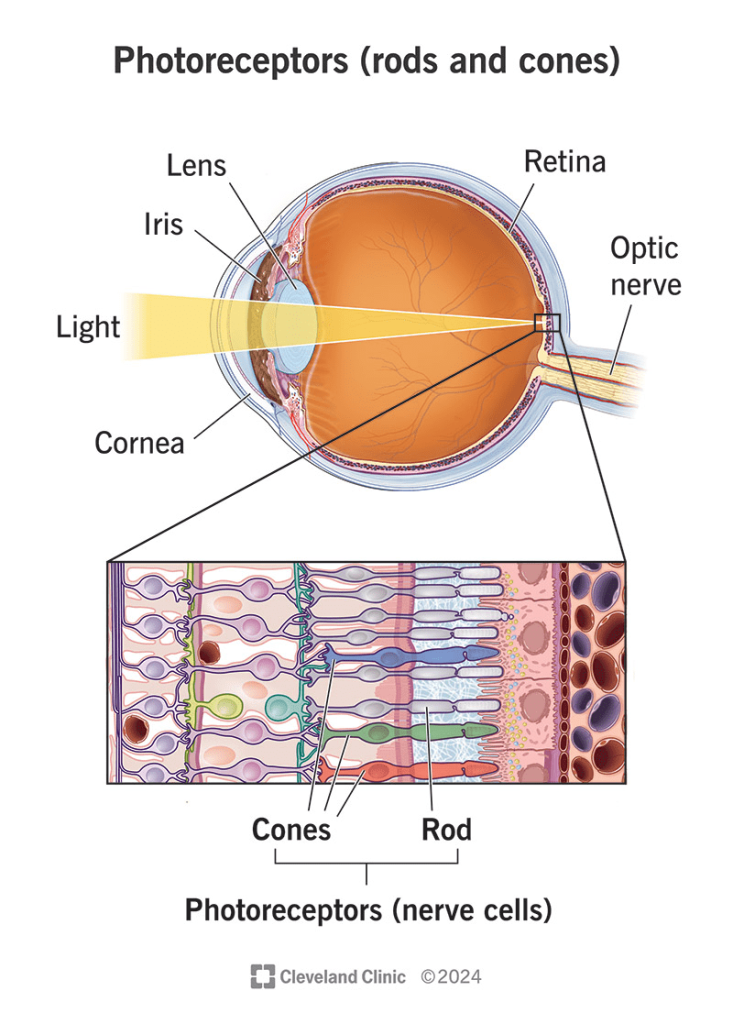
The idea of total colorblindness in dogs did not emerge from malice or laziness. It was the product of early scientific efforts, based on the best available evidence at the time. These early studies in visual anatomy and behavior lacked the tools and techniques to probe the finer details of canine perception. Researchers observed that, unlike humans who have three types of cone photoreceptors in the retina (a condition known as trichromatic vision), dogs possess only two. From this, a logical but flawed assumption took hold, that having fewer cones meant dogs could not perceive color at all. Without the means to measure subtle differences in how dogs responded to color stimuli, the myth of a black-and-white canine world was born and widely accepted.
This binary thinking was convenient but incomplete.
A More Accurate Picture
Today, we know that dogs do see color — just not the same range of color that humans do. Dogs are dichromats, which means their eyes have two types of cones. They can detect blue and yellow hues, but reds and greens blend into brownish or grayish tones.
Think of it as a world filtered through a faded vintage photo, muted but not colorless.

For a more specific analogy, imagine a human with red-green colorblindness. That is remarkably close to how dogs see the world. The red ball may appear as a dark brown or dull yellow, and a green lawn might blend into similar earthy tones. But a bright blue toy? That pops in a dog’s eyes.
How We Know This
Researchers have used both behavioral tests and anatomical studies to piece together the canine color palette. Dogs were trained to respond to different colored panels to receive treats. Time and again, they demonstrated the ability to distinguish between blue and yellow panels, even when brightness was equalized, meaning they were seeing color, not just light intensity.
And when researchers examined the canine retina, they found two types of cones responsive to wavelengths centered around blue-violet and yellow-green. Reds simply do not register as distinct.
“Dogs possess dichromatic vision and can distinguish colors in a limited range, particularly in the blue and yellow spectrum. Their visual performance is comparable to that of humans with red-green color vision deficiency.”
— Neitz, J., Geist, T., & Jacobs, G. H. (1989). Color vision in the dog.
Behavioral Neuroscience, 103(4), 619–625.
DOI:10.1037/0735-7044.103.4.619
So no, your dog is not blind to color. Their world is just filtered differently, not monochrome, but limited.
Why This Matters
Understanding what dogs actually see is more than just a curiosity. It affects everything from how we design training tools and toys to how service animals navigate environments.

A red object in green grass might be easy for a human to spot but nearly invisible to a dog. That matters when you are tossing a ball at the park or designing signage for guide dogs.
It also changes how we connect with them. The more we understand the sensory world of animals, the more we can interact with them on their terms rather than ours. That empathy makes us better caregivers, better trainers, and frankly, better scientists.
Subtle Differences
So the next time your dog tears across the park after a yellow frisbee, eyes locked, tail slicing the air, remember this: they see it. Not as a vague blur, but as a real and meaningful color. It may lack the saturation you perceive, but in their eyes, that yellow cuts clearly through the muted tones of grass and ground. Their vision, shaped by evolution, is not flawed. It is purpose-built — tuned to detect motion, recognize shapes, sense contrast, and identify just the colors that matter most for survival and connection.
Dogs do not need our full spectrum to live fully. Their world may be painted with fewer hues, but it is rich in clarity, action, and meaning. Blue skies, yellow toys, familiar faces, and shared adventures — all seen through a lens perfectly crafted for their role in our lives.
Their world is not black and white. It never was.