
A lot of people think humans came from monkeys or apes we see today, like chimpanzees or gorillas. This isn’t exactly correct, but it’s also not wrong either (yes, that can be confusing). To answer why humans didn’t evolve from monkeys, we need to clarify one of the biggest mix-ups in how people understand evolution.
What really happened is that humans and today’s monkeys and apes all came from a shared ancestor that lived a long, long time ago—millions of years back. That ancestor wasn’t a human or a modern monkey, but over time, its descendants split into different groups. Some eventually became monkeys, some became apes, and one group—our group—became humans.
So, humans didn’t come from monkeys. We’re more like distant cousins who share the same great-great-great-grandparent from way back in time.
To better understand this, think of your family tree. You and your cousins didn’t evolve or descend directly from one another, yet you share common grandparents who are your shared ancestors. Similarly, humans, chimpanzees, gorillas, and other modern apes share an ancient common ancestor species that existed roughly 5 to 7 million years ago. This ancestor wasn’t exactly like modern apes or humans – it had characteristics that, over countless generations, evolved in different directions due to various environmental pressures.
Getting The Wrong Idea
Misconceptions about evolution often arise because the idea of evolution itself can be challenging to visualize. Many people imagine evolution as a straight, linear progression where one species morphs directly into another. One reason the misconception persists is due to oversimplified illustrations or outdated evolutionary diagrams often shown in educational materials. For example, the famous “March of Progress” illustration—showing a chimpanzee-like figure gradually becoming an upright modern human—has inadvertently reinforced the incorrect idea that modern apes directly became humans. While visually appealing, such images inaccurately suggest a straightforward, step-by-step progression rather than a complex, branching process.
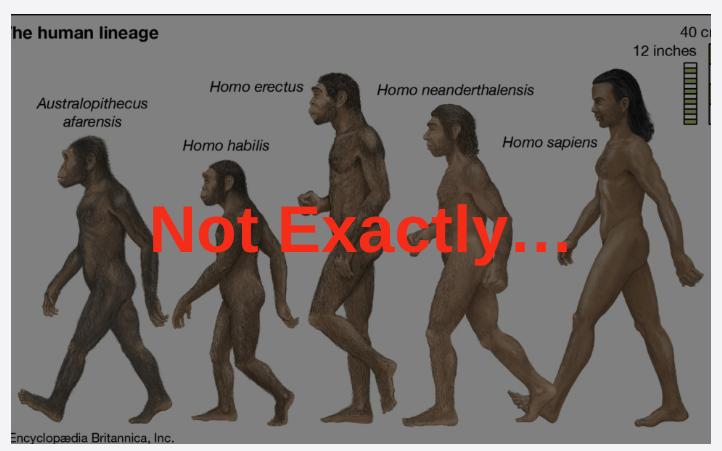
However, evolution is better visualized as a branching tree or bush, with species constantly splitting, adapting, and evolving along separate paths. New species emerge through a process called speciation, where populations gradually accumulate genetic differences over time until they become distinct species.
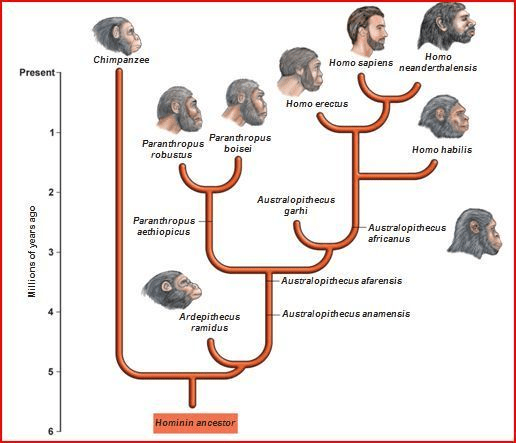
Additionally, language and semantics also play a role. Phrases such as “humans came from monkeys” can unintentionally promote a misunderstanding of evolutionary relationships. Evolutionary scientists emphasize careful phrasing, clearly distinguishing between “common ancestor” and “descendant species.”
Who Were These Ancestors?
Over the past 7 million years, a series of human ancestors have evolved through gradual changes. One of the earliest known is Sahelanthropus tchadensis, who lived in Central Africa and may have walked upright, though still looked very ape-like. Later came Ardipithecus ramidus (“Ardi”), found in Ethiopia, who lived in both trees and on the ground, showing a transition to bipedalism.
Then about 3 to 4 million years ago, Australopithecus afarensis emerged—most famously represented by the fossil “Lucy.” These ancestors walked upright more regularly and lived in both forests and open grasslands. Homo habilis, or the “handy man,” appeared around 2.4 million years ago and is one of the earliest known tool users.
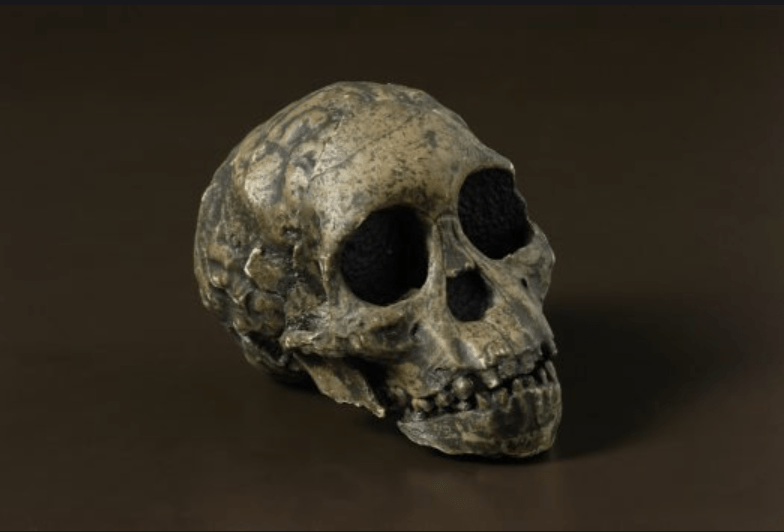
Later, Homo erectus spread from Africa into Asia and Europe. They had larger brains, used fire, and traveled in groups. Finally, Homo sapiens—our own species—appeared about 300,000 years ago in Africa, developing language, culture, and eventually forming modern civilizations.
Each of these ancestors represents a key branch in the human evolutionary tree, helping us understand how small changes over time led to the modern human experience.
Imagine This
To grasp evolution more clearly, consider whales and dolphins. These marine mammals evolved from land-dwelling ancestors millions of years ago. They share a common ancestor with modern land mammals, yet whales and dolphins aren’t descendants of present-day animals such as cows or hippos—they simply share a distant ancestor. This example illustrates how species can diverge dramatically in appearance, lifestyle, and adaptation while still sharing a common evolutionary lineage.
Over millions of years, descendants of the ancestor species shared by humans and apes evolved separately. Some groups developed adaptations suited for tree climbing, leading to today’s modern apes. Meanwhile, another group adapted to life on the ground, evolving features like upright walking, enhanced cognitive capabilities, and tool use, eventually giving rise to modern humans.
Important Reading
For further reading and deeper understanding, you can explore seminal works and research such as:
- Charles Darwin’s foundational book, “On the Origin of Species”: https://darwin-online.org.uk/
- The Human Evolution research collection at the Smithsonian National Museum of Natural History: https://humanorigins.si.edu/
- The extensive fossil record documented by the Leakey Foundation: https://leakeyfoundation.org/
TL;DR Why humans didn’t evolve from monkeys?
Humans didn’t evolve directly from today’s monkeys or apes but instead share a common ancestor with them. Understanding this branching evolutionary process helps clarify misconceptions, highlights the complexity of life’s history, and fosters greater respect for all living organisms.