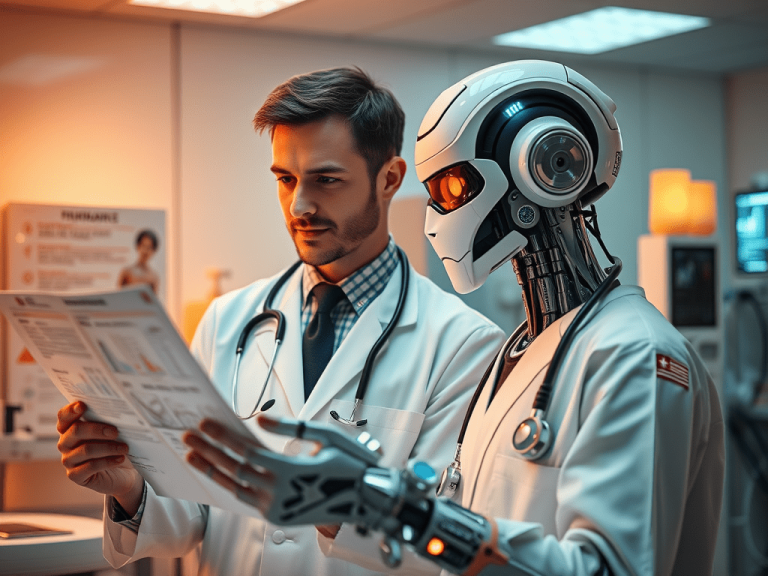
Artificial Intelligence (AI) is rapidly transforming many industries, and healthcare is no exception. One of the most debated questions today is can AI replace doctors. While headlines often sensationalize AI’s capabilities, the reality is nuanced. AI indeed holds the potential to replace certain roles doctors currently fulfill. However, significant gaps exist currently that prevent it from fully taking over medical responsibilities. So the short answer is yes, but there is still work to do. Read on to learn more.
Imagine the future: a world where routine diagnostics are completed in seconds, errors in medical imaging are drastically reduced, and doctors have more time to focus on patient care. AI could make healthcare more efficient, accessible, and consistent. With 24/7 availability and the ability to process massive datasets in real-time, AI could help close gaps in care, particularly in underserved regions. It may also reduce healthcare costs by automating repetitive tasks and streamlining patient triage. A single AI bot could provide health assessments of thousands of people at the same time, and no more traveling and waiting at the doctors office. Sounds nice, right?
Here’s what the evidence says:
The Current Capabilities of Medical AI
AI technologies, such as machine learning algorithms and neural networks, have already demonstrated impressive abilities. AI excels at tasks like image recognition, where algorithms detect abnormalities in X-rays and MRI scans, sometimes outperforming human radiologists. Studies published in Nature Medicine and the Lancet Digital Health show that AI can accurately identify conditions such as cancerous tumors, diabetic retinopathy, and heart conditions at speeds and accuracy rates comparable or superior to experienced doctors.
Misconception: AI Can Replace Doctors Now
Despite these promising developments, at the current moment there are still limitations to having a fully AI healthcare experience. A study published in BMJ Open highlighted significant limitations in AI’s ability to understand complex patient narratives, apply ethical reasoning, or offer compassionate care. Doctors perform nuanced tasks involving empathy, ethical judgment, and contextually rich decision-making that current AI models simply can’t match. However, given the rapid advances in the field of AI, its not unreasonable to see this happening in the near future (hint: it might be close than you think!)
Highlighting the Gaps: What AI Currently Lacks
1. Empathy and Human Connection
Healthcare is inherently personal. Patients often require emotional support, empathy, and trust—areas where AI remains inadequate. Research from the American Medical Association emphasizes that human connection significantly impacts patient outcomes, adherence to treatments, and overall satisfaction.
2. Ethical Judgment and Complex Decision Making
Medicine involves making ethically challenging decisions that sometimes deviate from standardized procedures. AI algorithms, trained on historical data, often struggle with these nuanced ethical judgments, which rely heavily on human values and context-specific understanding.
3. Handling Novel or Unpredictable Situations
AI models depend on existing datasets. This means they can falter when encountering novel medical conditions or atypical presentations. Human doctors, by contrast, are trained to think creatively and adaptively, traits vital in unpredictable clinical scenarios.
What the Research Indicates About AI vs. Doctors
A comprehensive analysis published in the Journal of Medical Internet Research compared diagnostic accuracy between AI-driven tools and medical professionals. AI consistently excelled in accuracy for routine, clearly defined conditions. In contrast, doctors performed better in complex, ambiguous cases. These required judgment beyond algorithmic pattern recognition.
Moreover, research in The Lancet underscores the best results come from AI and doctors working together rather than separately. AI tools significantly enhance doctors’ efficiency and accuracy, but human oversight remains crucial to manage anomalies and ethical complexities.
Moving Toward a Future Where AI Could Replace Doctors
Yes, AI has the potential to replace many of the tasks doctors perform today—but reaching this point requires significant advancements:
- Improved contextual understanding: Future AI systems must accurately interpret and integrate patient narratives and complex medical histories.
- Advancements in emotional AI: Emotional intelligence must improve drastically for AI to effectively manage patient interactions and emotional support.
- Enhanced adaptability: AI must evolve to handle unpredictable, novel clinical scenarios effectively.
Conclusion: Collaborative Future, Not Replacement
While the dream of AI fully replacing doctors is enticing, current evidence makes it clear we aren’t there yet. AI is undoubtedly transforming healthcare by improving diagnostic accuracy, streamlining workflows, and allowing doctors more patient-facing time. However, full replacement demands AI advances beyond present capabilities. Ultimately, in the near future, AI will augment human doctors instead of replacing them. This will create a collaborative environment. Patients will benefit from the strengths of both human intelligence and artificial precision. Beyond that, I believe that AI will replace 90% of the healthcare industry, from delivering life-saving healthcare to managing the administration and payments. But time will tell.
Want to learn more about decoding science? Visit our Foundations section to explore core topics of science literacy and understanding.